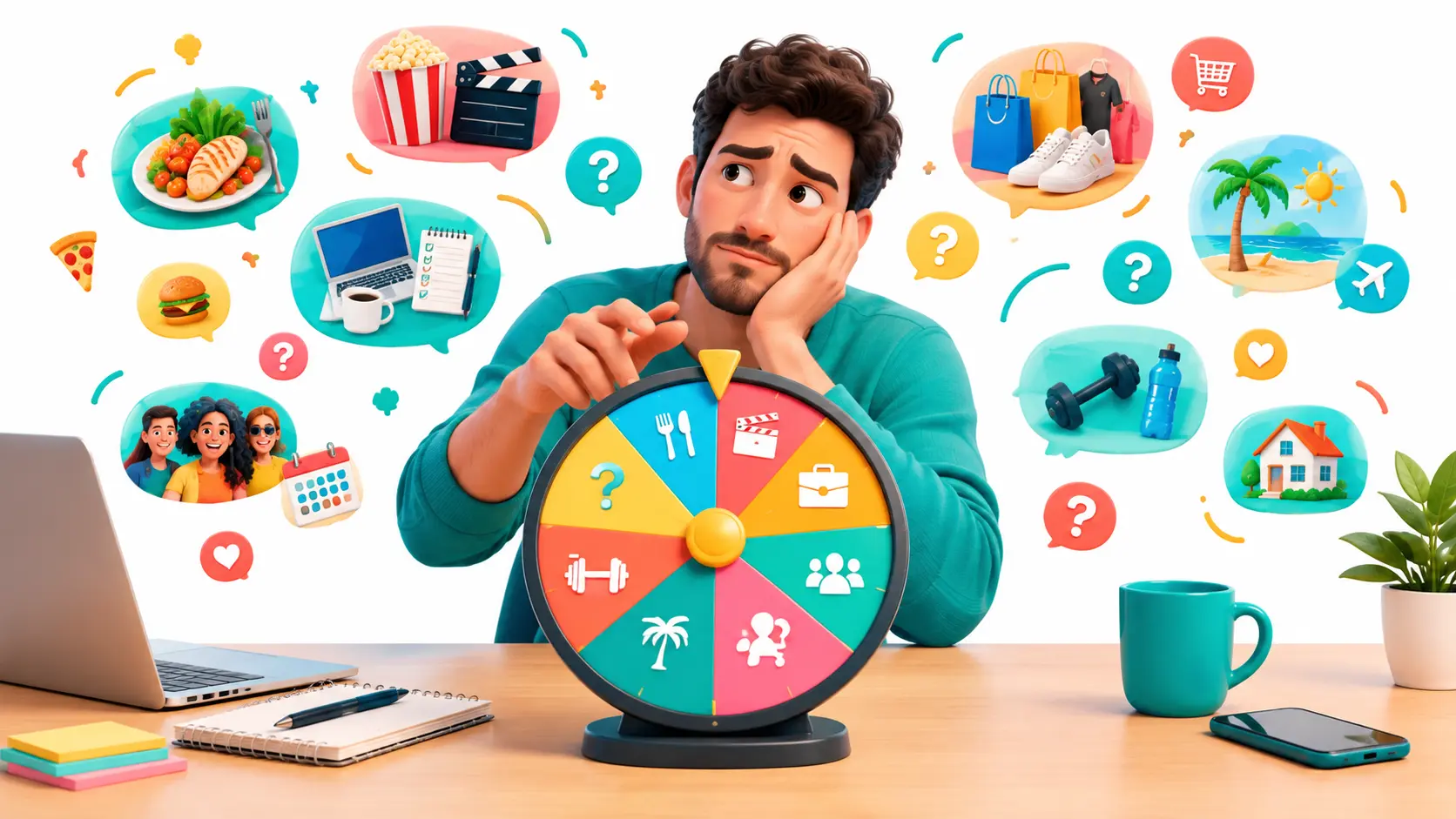
There is a specific kind of exhaustion that no amount of sleep can cure. It is the exhaustion of having made one too many decisions. You know the feeling: standing in front of the fridge at 8 PM, unable to choose what to eat. Or scrolling through Netflix for 40 minutes only to rewatch the same show for the fifth time. Or staring at your to-do list, paralyzed by the sheer number of options, until you close the laptop and do nothing at all.
This is decision fatigue, and as a sociologist, I have spent the last decade studying how it shapes modern life. What I have found is both troubling and hopeful: our brains were never designed for the number of choices we face daily, and yet, there is a surprisingly simple and effective solution that has been hiding in plain sight.
That solution is the random choice wheel—a tool that seems trivial at first glance, but which, when used correctly, can restore hours of mental energy every single week. In this article, I will explain the sociology behind decision fatigue, why it is getting worse, and how a simple random picker wheel can become one of the most powerful productivity tools in your daily life.
What Is Decision Fatigue? A Sociologist's Perspective
Decision fatigue is not a buzzword invented by productivity gurus. It is a well-documented psychological and sociological phenomenon. In the 1990s, social psychologist Roy Baumeister and his colleagues demonstrated that human willpower behaves like a finite resource—much like a muscle that tires after prolonged use. Every decision, no matter how trivial, draws from the same limited reserve.
But here is what makes this a sociological issue and not just a psychological one: the number of decisions we are asked to make has exploded in the last fifty years. My research, alongside that of scholars like Barry Schwartz (author of The Paradox of Choice), shows that a typical adult in an industrialized society now faces between 20,000 and 35,000 micro-decisions every single day. From the moment we wake up—should I hit snooze? What should I wear? What should I eat for breakfast?—we begin draining our cognitive batteries.
By early afternoon, most of us are running on empty. And that is when the real damage happens. Studies show that decision fatigue leads to:
- Impulse purchases — We buy things we don't need because we can't resist the easiest option.
- Avoidance behavior — We procrastinate on important tasks because choosing is too exhausting.
- Poor judgment — We snap at colleagues, make careless mistakes, and lose our tempers.
- Decision paralysis — We freeze entirely, unable to move forward on anything.
- Decreased satisfaction — Even when we do choose, we regret the outcome.
If you recognize yourself in this list, you are not weak. You are human. And you are living in a society that has been engineered—by advertising, by technology, by the very structure of modern commerce—to overwhelm your decision-making capacity.
Why Our Brains Weren't Built for the Modern World
To understand why decision fatigue is so severe today, we need to look back at how the human brain evolved. For most of our species' history, choices were simple and survival-based. Should I hunt or gather? Should I stay here or move? These decisions were few and consequential, and they were made in a context of scarcity.
Today, the situation is radically different. We are not deciding between survival options—we are deciding between hundreds of variations of the same thing. There are 40 types of toothpaste at the supermarket. There are 5,000 shows on Netflix. There are 200 items on an average restaurant menu. And every single one of these choices demands a tiny fragment of our mental energy.
The problem is compounded by what sociologists call "the tyranny of small decisions." Each individual choice seems trivial—"Which pen should I use?"—but collectively, they exhaust us before we even reach the decisions that actually matter. This is why you can feel completely drained at 11 AM, even though you have not done anything objectively difficult.
💡 The Sociological Insight
The modern world does not just give us more choices—it gives us more meaningless choices. And meaningless choices are often more draining than meaningful ones, because they offer no clear payoff for the energy they consume.
The Hidden Cost of Decision Paralysis
When I interview people about their daily struggles, one theme comes up again and again: the inability to move forward. It is not that they don't know what to do—it is that they cannot decide where to start. And so they do nothing. This is decision paralysis, and it is one of the most damaging consequences of decision fatigue.
Here is why it matters: every minute spent paralyzed is a minute not spent living. Every hour spent scrolling Netflix is an hour not spent with loved ones. Every day spent avoiding difficult decisions is a day that slips through your fingers.
The research is clear: people who suffer from chronic decision paralysis report lower life satisfaction, higher anxiety, and poorer overall mental health. They are also more likely to experience burnout, relationship problems, and even physical health issues.
But here is the hopeful part. When I began studying the habits of people who seemed to resist decision fatigue—people I call "cognitive minimalists"—I found a consistent pattern. They did not try to make better decisions. They tried to make fewer decisions altogether.
The Random Choice Wheel: A Sociologist's Favorite Solution
This is where the random choice wheel enters the conversation. On the surface, it looks almost too simple: a colorful spinning wheel with options that randomly selects one for you. But as a sociologist, I can tell you that this simple tool addresses the core of the problem in three profound ways.
1. It Removes the Emotional Weight of Choice
When you make a decision yourself, you carry the emotional weight of that decision. You wonder: Did I choose right? What if the other option was better? Will I regret this?
A decision wheel removes that weight entirely. The wheel chose, not you. There is no room for regret, because the outcome was not your responsibility. This sounds almost too easy—but it works. In my interviews, I consistently found that people using random wheels felt relief rather than regret.
2. It Converts Decision Paralysis into Action
When you are paralyzed by choice, the problem is not that you can't decide—it's that every option feels equally valid and equally uncertain. A random wheel cuts through that paralysis in seconds. You spin, you commit, and you move on.
This is why I often recommend a random spin wheel to students struggling with procrastination. The act of spinning is a physical commitment—a gesture that says "I am moving forward, no matter what the outcome."
3. It Preserves Mental Energy for What Matters
Every small decision you outsource to a wheel is a decision you don't have to make yourself. This preservation of mental energy is the true value of the tool. You don't have to decide what to eat, what to watch, or what to wear—the wheel does. And what you get in return is the mental bandwidth to focus on what actually matters: your relationships, your career, your health, your passions.
The Science Behind the Wheel
You might be wondering: is this really based on science, or is it just a pleasant idea? The answer is: it is based on solid research. Cognitive scientists have known for decades that randomization reduces cognitive load. When you remove the need to evaluate options, you free up working memory, reduce stress, and make quicker decisions.
Studies at institutions like Princeton and Stanford have shown that the human brain uses less energy when tasks are automated or outsourced—even if the task is as simple as picking a restaurant. And a 2023 study on choice psychology found that people who used random decision-making tools reported higher satisfaction with their outcomes, not lower.
This last point is counterintuitive but profound: when you let chance decide, you stop being the critic of your own choice. You cannot regret a decision you did not make. And that psychological freedom is worth more than any "optimal" choice ever could be.
How to Use Random Choice Wheels in Daily Life
Let me share some practical ways to integrate random choice wheels into your life. These are based on my own experience and on interviews with dozens of people who have adopted this practice.
For Meals
Create a wheel with your go-to restaurants or meals. Spin it when you cannot decide. This is one of the most popular uses of a random food picker.
For Entertainment
Create a wheel with movies, shows, or books. Spin it when you are stuck in streaming paralysis.
For Work
When your to-do list feels overwhelming, put your top tasks on a wheel and let it decide where to start. This technique—called "productive randomness"—is used by many successful entrepreneurs and creatives.
For Social Events
Use a name picker to assign responsibilities for parties, trips, or group activities. It removes the social friction of choosing who does what.
For Creative Work
Writers, designers, and artists can use random wheels to break through creative blocks. Put different prompts, themes, or techniques on the wheel and spin to see what comes up.
The Sociology of Trust: Why the Wheel Works
One final observation, from a sociological perspective: we trust the wheel more than we trust ourselves. This is a powerful finding. When we make a decision ourselves, we question it. When the wheel makes it, we accept it. This is because the wheel is objective—it has no stake in the outcome, no hidden bias, no social pressure.
In a world where every choice is scrutinized—by ourselves, by others, by social media—the wheel offers a rare gift: a decision made without judgment. And in my research, I have found that this gift is more valuable than any optimization strategy could ever be.
So the next time you find yourself paralyzed by choice, remember: you do not have to make every decision yourself. The wheel is there. Let it spin. Let it decide. And save your mental energy for the things that truly matter.
Ready to Fight Decision Fatigue?
Create your own random choice wheel in seconds. Free, fast, and surprisingly effective.
🎡 Try PickRandomSpin Now👤 About the Author
Ben Abder
Sociologist & Researcher
Ben Abder is a sociologist specializing in decision-making behavior, choice overload, and the sociology of modern life. His research explores how technology and culture shape our daily decisions, and how simple tools can restore our cognitive well-being.